
Bunching Charitable Contributions with a Donor-Advised Fund
A thoughtful approach to planning when and how you give can help you make the most of your charitable contributions. Read about how bunching with a DAF can maximize your potential tax deduction while setting you up for future grantmaking.

A commitment to a cause often extends well beyond the gift made today. You may want to sustain a nonprofit organization’s work for years or make room for new philanthropic priorities. Planning for that future means considering both what you want to support and how to fund your giving.
Your charitable priorities may remain consistent even as your income and financial circumstances change. The timing of your contributions can reflect those changes without interrupting your support for the organizations that matter to you.
In 2026, new federal tax rules give donors another reason to consider that timing. One approach worth considering is bunching charitable contributions.
How 2026 Tax Rules Affect Bunching Charitable Contributions
Bunching means concentrating several years of planned charitable contributions into a single tax year. It has long been a way to coordinate charitable giving with itemized deductions. Beginning in 2026, a new deduction threshold adds another consideration.
Taxpayers who itemize can generally deduct eligible charitable contributions only to the extent that their total exceeds 0.5% of adjusted gross income (AGI). Because that floor applies annually, making separate contributions each year can produce a different deduction outcome than combining the same contributions into one year.
How a DAF Supports a Bunching Strategy
A donor-advised fund (DAF) can support bunching by separating the timing of your charitable contribution from your grantmaking. You contribute several years of planned giving at once, claim a deduction in the contribution year, and recommend grants to qualified charitable organizations over time. This allows you to maintain annual support even when you contribute less frequently.
The assets you contribute are also part of the planning conversation. Appreciated securities may be an alternative to cash, although deduction limits differ by asset type and should be reviewed with your advisors.
How the Approach Can Work
Consider a hypothetical donor, Margaret, who plans to give $10,000 annually for the next three years. Assume her AGI remains $1 million each year and she otherwise expects to itemize throughout that period.
Under the 2026 rules, her annual charitable deduction floor is $5,000: 0.5% of her $1 million AGI. If she contributes $10,000 each year, her potential charitable deduction after applying the floor is $5,000 annually. Across three years, she contributes $30,000 and has $15,000 in potential charitable deductions.
Now consider the same commitment funded differently. Margaret contributes $30,000 to a DAF in the first year, representing all three years of planned giving. After applying that year’s $5,000 floor, her potential charitable deduction is $25,000. She can then recommend approximately $10,000 in grants annually over the three years.
The total charitable commitment remains $30,000. In this illustration, concentrating the contribution in one year produces $10,000 more in potential charitable deductions than contributing annually. That is an increase in deductions, not a dollar-for-dollar increase in tax savings.
The comparison illustrates why it is useful to evaluate contributions across several years rather than in isolation. Your own outcome will depend on your income, other deductions, and applicable tax limitations.
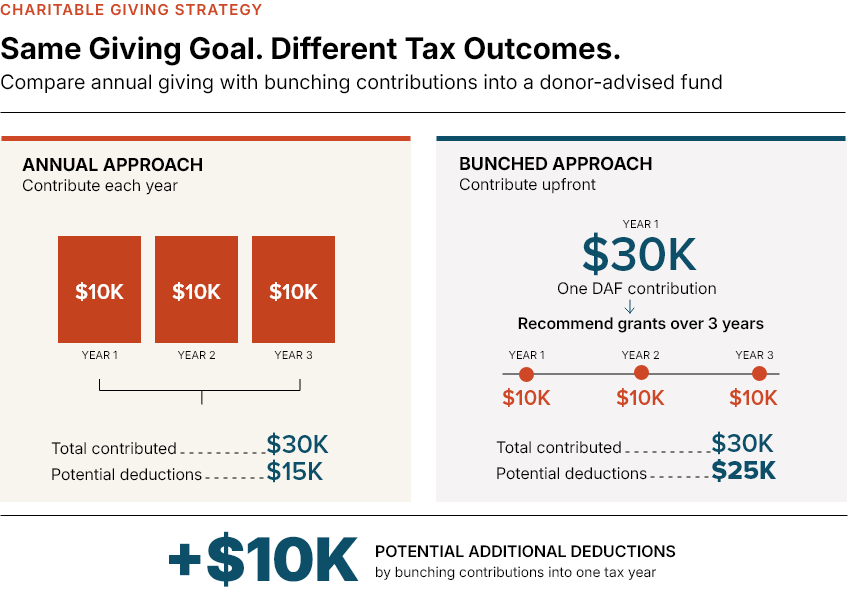
This hypothetical example is for educational purposes only. It assumes constant annual AGI of $1 million, that the donor otherwise itemizes each year, and no additional charitable contributions. It isolates the effect of the 0.5% floor and does not calculate tax savings or account for all applicable rules, limitations, or individual circumstances.
When to Consider Bunching Charitable Contributions
The most useful starting point is the giving you already intend to do. From there, your advisors can help assess whether concentrating contributions would fit your financial circumstances.
You Have an Established Charitable Commitment
If you regularly support certain organizations, you may already have a reasonable picture of your giving over the next several years. Bunching offers a way to fund that commitment in advance while continuing to recommend grants annually. The new AGI floor makes the comparison between annual and concentrated contributions particularly relevant.
This is less about changing your charitable priorities than reviewing how you provide for them.
Your Itemized Deductions Vary from Year to Year
You may itemize in some years and take the standard deduction in others. A larger charitable contribution can help bring total eligible itemized deductions above the standard deduction in the contribution year, while you may take the standard deduction in subsequent years.
Rather than assuming the same contribution schedule will produce the best result every year, your advisors can compare the approaches over the full period you intend to fund.
You Expect an Unusually High-Income Year
A substantial bonus or business sale may create an opportunity to fund future charitable giving during a year of elevated income. A DAF allows you to make the contribution in that year without requiring you to decide on every future grant at the same time.
If a business sale or other transaction is being considered, begin the conversation early. The available contribution options can depend on the asset, transaction structure, and timing, as well as the DAF sponsor’s review and acceptance requirements.
You Are Approaching Retirement or Another Income Transition
Your charitable goals may continue into retirement even if your earnings decline. Bunching before retirement can be worth evaluating alongside other plans for that transition, particularly if you expect to move into a lower tax bracket.
The comparison should account for the current deduction rules, not simply your marginal tax rate. Beginning in 2026, the federal tax benefit of itemized deductions is generally limited to 35% for taxpayers in the top 37% bracket. Your advisors can assess how that limitation affects the value of contributing before or after an income change.
Planning Around the Commitment You Want to Sustain
As you review your year-end plans, consider the giving you anticipate beyond December. Your financial and tax advisors can help evaluate alternative plans. National Philanthropic Trust (NPT) can support the contribution process, including questions about asset types and year-end timing. To discuss next steps, contact NPT’s Donor Relations team at (888) 878-7900.

About the Author
Elizabeth brings a unique blend of financial services, nonprofit executive leadership, and philanthropic strategy to her work with advisors and UHNW clients. She began her career in investment management industry and later helped start Vanguard’s ETF distribution by partnering with leading private wealth firms across the Midwest. Most recently, she served as President of Regina Dominican High School and today collaborates with private bankers and clients to integrate charitable giving into broader legacy, estate, and wealth planning strategies.
NPT does not provide legal, tax or investment advice. This blog post is for informational purposes only and is not intended to be, and shall not be relied upon as, legal, tax or investment advice. The applicability of information contained here may vary depending on individual circumstances. Please consult your legal, tax or financial advisor.
The Philanthropist
Other Posts You May Like