Learn About DAFs
-
What is a Donor-Advised Fund (DAF)?
The most popular tax-efficient way to conduct your philanthropy.
A donor-advised fund, or DAF, is a giving account established at a public charity. The 501(c)(3) public charity serves as a “sponsoring organization,” which manages and administers individual DAF accounts.
DAF accounts allow donors to make a charitable contribution, receive an immediate tax deduction and then recommend grants from the fund over time. Donors can contribute to the fund as frequently as they like, and then recommend grants to their favorite charitable organizations whenever it makes sense for them. This allows donors to give when they can, then grant when it’s needed.
Get a Snapshot
How People Use DAFs to Fuel Their Philanthropy
52 B
dollars in grants from DAFs in 2022
2 B
individual DAF accounts in the United States
23 %
annual payout rate as of 2022
17 %
of all charitable contributions made to DAFs in 2022
Get a Snapshot
How People Use DAFs to Fuel Their Philanthropy
All statistics are as of 2022, sourced from the 2023 Donor-Advised Fund Report.
How Donor-Advised Funds Work

Donors Contribute
The donor makes an irrevocable contribution to the donor-advised fund (DAF) and can take an immediate tax deduction. See what you can contribute.

Assets May Grow
The charitable assets in the DAF may be invested, and any investment growth is tax-free for the donor. Explore tax benefits.

Charities Benefit
The donor recommends grants from the DAF assets to support qualified charities. Read grant impact stories.





History and Trends
The first donor-advised funds were created in the 1930s, though donor-advised funds were not recognized formally in the Code until the Pension Protection Act of 2006. In the 1990s, donor-advised funds began to grow in visibility and popularity, and today they are philanthropy’s fastest-growing vehicles. Grants from donor-advised funds account for more than 10 percent of all giving in the United States.
For a detailed look at donor-advised fund trends, you can view our most recent Donor-Advised Fund Report.
Benefits of a Donor-Advised Fund
DAFs have become popular in part because of their versatility, allowing donors to give when, what, how, and where is most favorable for them. There are many reasons why donors choose a donor-advised fund as a philanthropic giving vehicle. Charitable giving with a donor-advised fund can be a tax-efficient way to build a charitable legacy.
Here are the benefits of a donor-advised fund:
- Maximize tax benefits
- Contribute immediately, build a philanthropic strategy and donate when you’re ready
- Grow your contributions over time, making more charitable dollars available to nonprofits
- Guarantee philanthropic dollars reach the causes you care about with an irrevocable contribution
- Simplify organization and administration
- Create a charitable legacy
- Choose how you are acknowledged
- Develop a philanthropic vision and philosophy
- Reach international charities and NGOs while still receiving federal tax credit
DAFs vs. Private Foundations
DAFs and private foundations have similar goals, both being financial vehicles for philanthropic endeavors. The two differ from a legal standpoint, and each vehicle has different requirements, benefits and structures.
NPT can assist you in converting a private foundation to a donor-advised fund account, which will have less overhead, improved tax deductions and increased grant flexibility. Your foundation administrators can act as financial advisors and successors to the account in perpetuity. It is also possible for you to open a donor-advised fund as a complement and a companion to your existing private foundation, maximizing your tax benefits while achieving your philanthropic goals.
How to Get Started
To establish your donor-advised fund, you make an irrevocable contribution of personal assets—which could include cash, stock, real estate and more. Your contribution is recorded as a donation to NPT, and the balance will be reflected in your donor-advised fund account. National Philanthropic Trust accepts the widest range of assets, helping you turn just about any asset into philanthropic capital.
When you contribute to your donor-advised fund, you may be eligible to claim an itemized tax deduction for federal and/or state income tax purposes. Because National Philanthropic Trust and other donor-advised fund sponsors are public charities, your donation is considered a tax-deductible charitable contribution. The amount of the deduction will depend on several factors, including the type of asset donated and how long you have owned it. This arrangement allows you to plan your gift so that you can take the tax deduction when it makes sense for you and to recommend grants to your favorite charitable organizations at any point in the future.
Learn more about donor-advised fund tax benefits.
As you establish your donor-advised fund account, you can structure it in a way that best meets your charitable goals. You can name your donor-advised fund (DAF) anything you would like; appoint friends and family members to help you manage the responsibilities of a DAF; and design a Legacy Plan to determine what will be done with your DAF assets beyond your lifetime, which may include appointing successors or charitable beneficiaries.
You can recommend an investment strategy for the assets in your donor-advised fund account by selecting an allocation from among the pre-approved investment offerings. The assets in your DAF are invested following your recommendations. Any investment growth is tax-free, giving you the potential to create even more philanthropic capital for grantmaking.
As soon as your donor-advised fund is established and funded, you can recommend grants to the charitable organizations closest to your heart. NPT can approve grants to most organizations that are tax-exempt under Internal Revenue Code (Code) Section 501(c)(3) and classified as public charities under Code Section 509(a), as well as certain private operating foundations. Our team performs due diligence on every grant recommendation to ensure that your grant money will be used for charitable purposes. You can make single or recurring grants, either with recognition or with total anonymity.
About NPT
We make it easier for you to achieve your philanthropic goals.
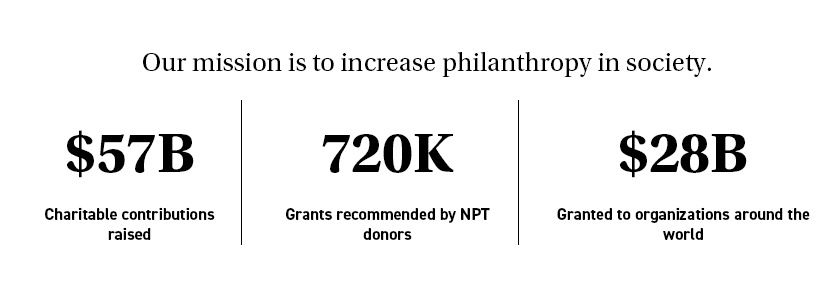
Founded in 1996, NPT is a national leader in donor-advised funds and one of the largest grantmaking institutions in the United States.
We are a public charity dedicated to providing philanthropic expertise to donors, foundations and financial institutions, enabling them to realize their philanthropic aspirations. Our mission is to increase philanthropy in society. Through our modern and mobile GivingPoint portal, we provide an enhanced giving experience for donors and trusted advisors.
NPT is proud to offer one of the most flexible donor-advised funds on the market. We are committed to leveraging our philanthropic expertise to help donors maximize charitable impact.
Do More with Donor-Advised Funds

Donate Now. Grant Later.
A DAF allows time for a donor to develop a philanthropic vision. Donors can make contributions to their fund, receive an immediate tax deduction and make grants to their favorite charities over time. Some donors make grants immediately after starting a DAF, while others take time to tailor a charitable giving strategy.
Explore Impact Strategies
Create Multi-Year Commitments to Your Favorite Charities.
Donors can use their DAFs to support their favorite charities—once, or for years to come. DAFs allow donors to use specialized grant agreements, recurring grants and anonymous grants to help reach their charitable giving goals.
Develop Your Philanthropic Strategy
Convert Illiquid Assets into Philanthropic Capital.
DAF sponsors accept a wide variety of assets as contributions, including illiquid assets. These can include real estate, works of art, collections, and other tangible personal property. In recent years, donating illiquid assets to DAFs has become a more popular trend. Donors are looking beyond their stock portfolios to view their total wealth as potential gifts to charity.
Explore complex asset contributions
Grant Highlights
Donors use DAFs to support charitable work around the world.





Keep Exploring
Additional Resources

IRS Requirements for DAFs
Learn More (External Link)
A Guide to Your Donor-Advised Fund
Read Now
DAF Insights for Advisors
Learn More